Case study / 2025–26
Quant Trade Simulator
An order-book simulator that prices an execution plan, pauses for human approval, and replays the plan against recorded trades.
- My contribution
- I built the order-book simulator, the plan review step and the read-only MCP tools for inspecting execution plans.
- Verification
- The advisor evaluation used four models and eight scenarios. A wrong-side recommendation and a plan that ignored available depth became explicit checks.
- Evidence
- Advisor evaluation results
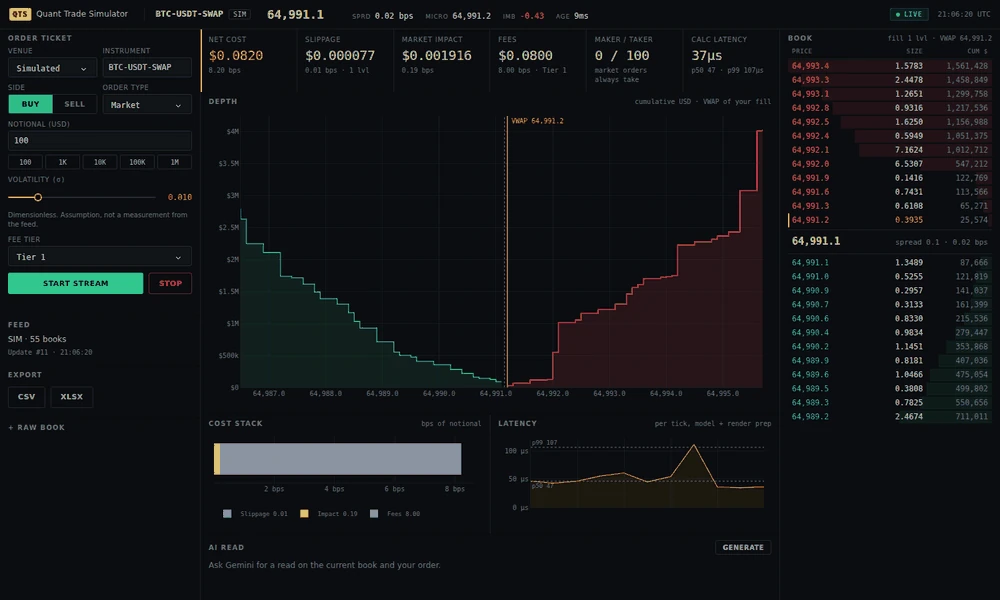

Give a plan a price
I built a simulator around Level 2 order-book data. It lets an operator inspect spread, available depth and estimated slippage before choosing how to split an order. A LangGraph agent proposes a plan and a deterministic critic checks its assumptions.
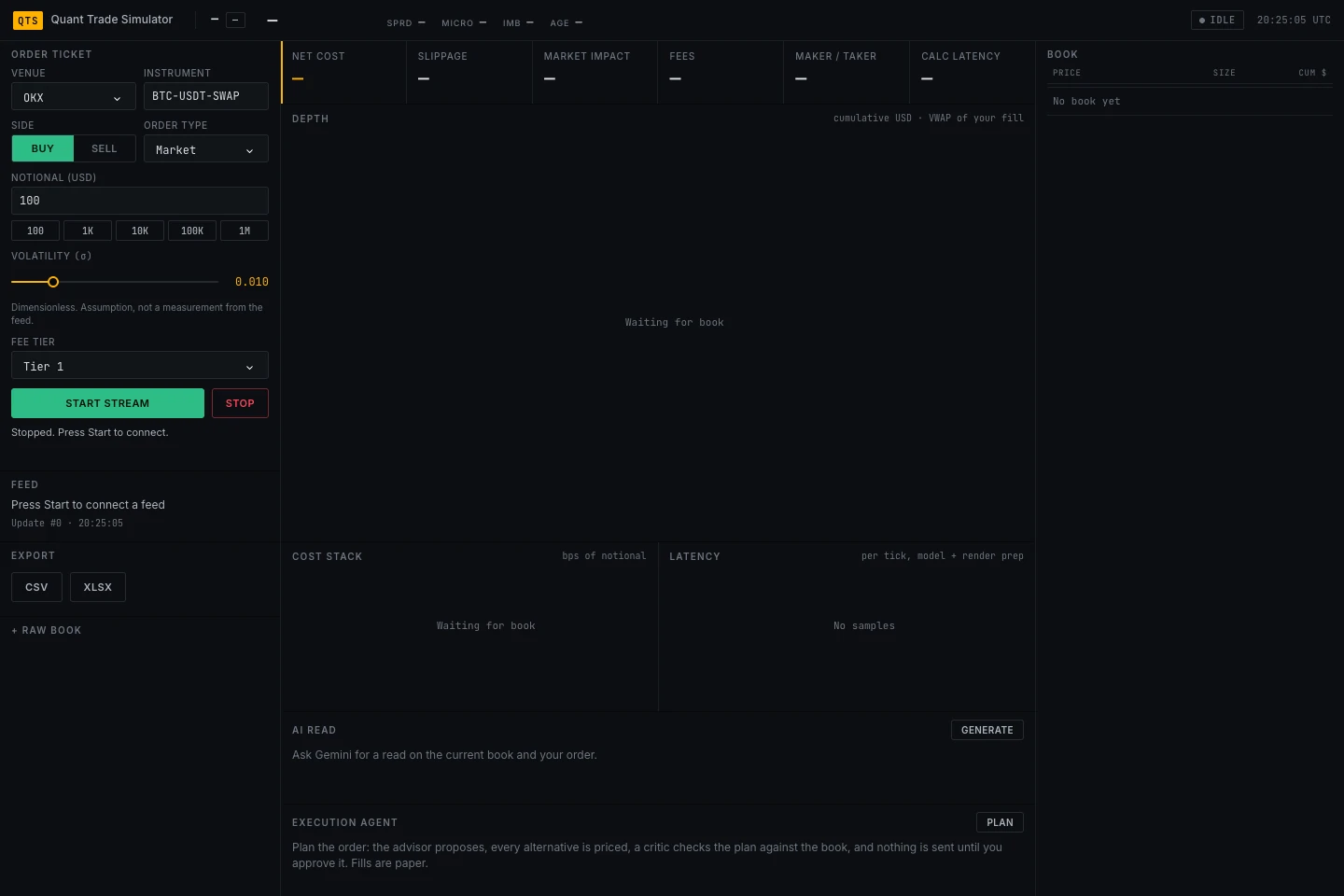
Run the counterfactual
The evaluation replays execution plans over a 15-minute BTC-USDT-SWAP recording containing 818 order books and 19,027 trades. Each plan faces the same observed sequence of market changes, so differences between estimated cost and replay cost are inspectable.
Let another client inspect a plan
I exposed six read-only MCP tools for quoting an order, inspecting the book and reviewing a proposed schedule. I evaluated the advisor across four models and eight recorded scenarios. A wrong-side recommendation and a plan that ignored available depth became explicit checks in the critic.
Inspect a failed assumption
A resting order can miss its fill precisely when the price moves away. In the published replay, this made the simulated expected fill too cheap. The study reports cost by order size and exposes the assumptions behind each estimate. All executions stay inside the simulator.